⭐ Darkwood Daily — From point cloud to forest: five creations around LiDAR and AI
on November 23, 2026

Darkwood Daily starts from the articles and links selected in Navi the previous day, then asks what the same subject can become across five different media. For the November 23, 2026 edition, the November 22 selections led to a simple question: how can the structures of living systems remain readable when observation takes the form of a point cloud?
The common thread is LiDAR, a technique that measures distance using pulses of light. It can represent in three dimensions surfaces and volumes that are difficult to describe with a flat image. Here, that idea is not used to produce five copies of the same content. It becomes, in turn, a game rule, visual movement, a musical motif, a processing chain and a geographic comparison.
Scientific source: a landscape made of points
The Calperum LiDAR dataset, published on Zenodo, contains data related to a vegetation landscape observed in three dimensions. A point cloud associates many measurements with positions in space. Depending on density, resolution, sensor and processing, these points can help distinguish the ground, low vegetation layers and the canopy.
This representation remains a measurement, not the forest itself. By itself, it cannot determine a species, health condition or ecological cause. The five creations below therefore reuse the ideas of structure and point reading without presenting their demonstrations as scientific results derived from the Calperum dataset.
Darkwaar — Canopy Relay
In Canopy Relay, the cloud becomes a 5×5 logic grid. The player starts at a root node and must reach the crown by selecting neighbouring points only. Four surveys create a short progression; gaps require reading the structure before acting, and three scan errors end the attempt.

Connect a root to the crown, one neighbouring point at a time, across four 5×5 grids with no more than three scan errors.
HeroClip — Forest of Signals
Forest of Signals transposes the same subject into a vertical procedural animation. Isolated points gather, lines respond to one another and a forest of signals takes shape over time. The clip does not attempt to reconstruct a scientific acquisition: it explores depth, circulation and emergence through a visual language inspired by point clouds.
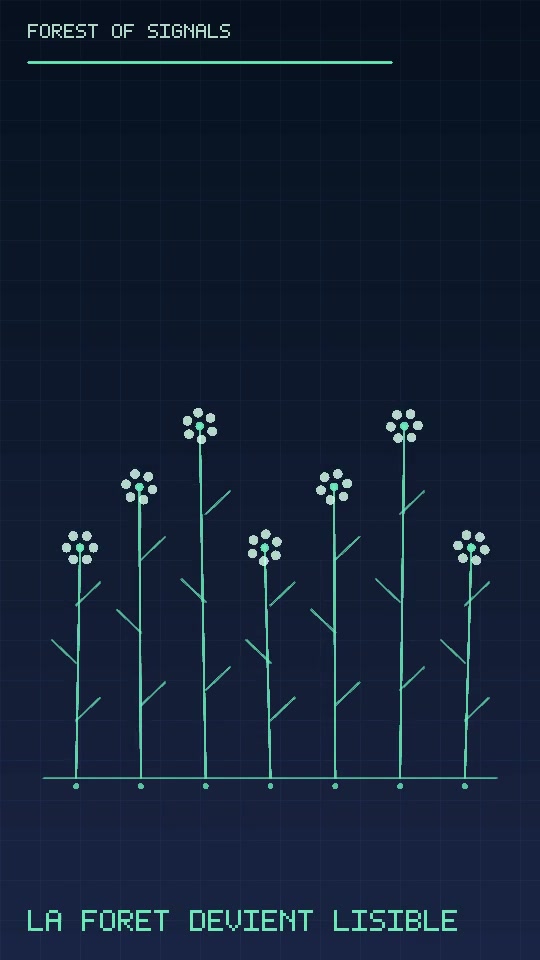
A vertical procedural animation in which points, layers and connections gradually compose a forest of signals.
DJ Matyo — Forest Echoes
For Forest Echoes, DJ Matyo focuses less on the image of a tree than on returns and layers. The original composition moves at 128 BPM: pulses, echoes and superimposed motifs suggest a signal passing through several vegetation heights. Musical details appear and disappear, as if the listener were moving through different point densities.
An original 128 BPM electronic composition built from layers, pulses and echoes around the motif of a measured forest.
Uniflow — LiDAR Canopy Classifier
The LiDAR Canopy Classifier workflow demonstrates a simple processing chain: receive points, apply explicit thresholds, then classify them as ground, shrub or canopy. The public flow can be imported and executed in the Uniflow editor.
Its bundled data only demonstrates how the workflow operates. It is neither a validated classification of the Calperum dataset nor a general scientific method. In a real project, thresholds, units, calibration, coverage and measurement quality would have to follow the dataset documentation and domain validation.
Open LiDAR Canopy Classifier in Uniflow
Geo — Forest Europe 2023
The Forêt Europe 2023 Card widens the view. It compares the share of land covered by forests in European countries using the official Eurostat indicator sdg_15_11, for 2023, in percent. Missing values remain visible and the source is stated so that the comparison is not detached from its unit or reference year.
The European statistic and the LiDAR dataset do not describe the same object: one compares an aggregated indicator across countries, while the other captures local three-dimensional structure. Their connection in this article is editorial, not methodological.
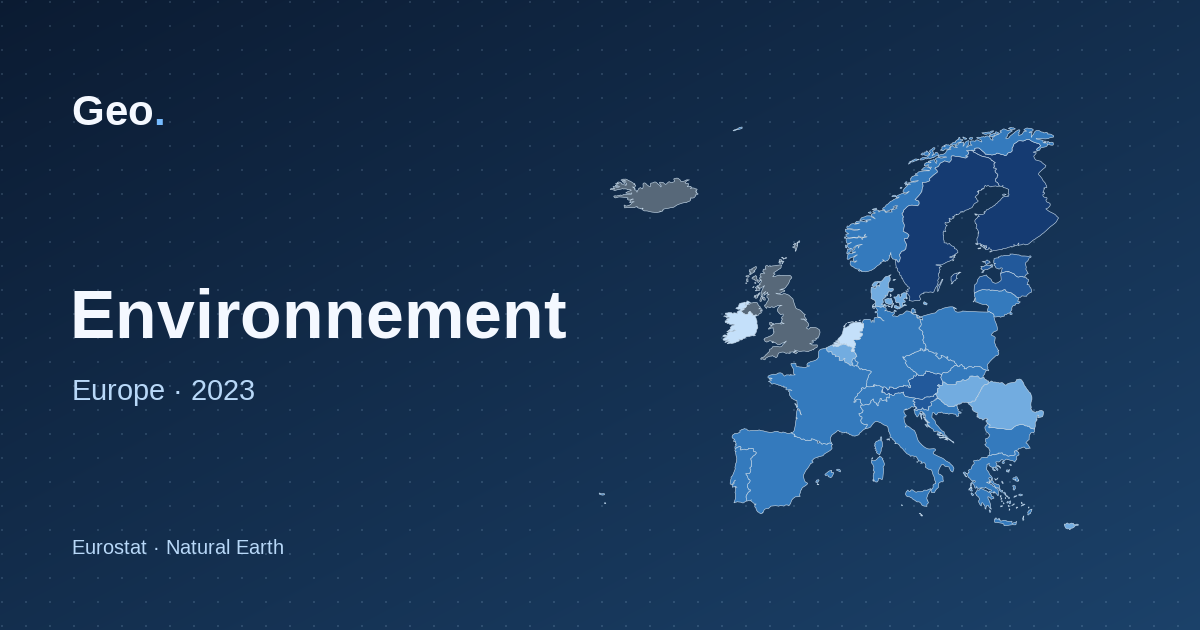
Share of land covered by forests in Europe, Eurostat indicator sdg_15_11, year 2023, unit %.
Explore the Forêt Europe 2023 map
Five readings of the same structure
The game asks the player to choose a path. The clip makes emergence visible. The music organises returns in time. The workflow makes a data transformation explicit. The map places a measure within a European comparison. None of these objects replaces the scientific source; each offers another way to grasp its intuition.
That is the principle of Darkwood Daily: begin with a documented selection, preserve the limits of the sources, then let each product build a form of its own.