🌲 Darkwood: A new chapter with PHP 8.6 and Symfony 8.2
on November 29, 2026
This week, Darkwood released five PHP packages and upgraded its main applications to Symfony 8.2. At the same time, the products started sharing more of their interface and sign-in experience. The connection between those changes matters more than the version numbers. A new product can reuse a server setup, a design and a sign-in flow, then spend its development time on the work it was built to do.
PHP 8.6 and FrankenPHP in production
Darkwood now runs PHP 8.6.0 and FrankenPHP 1.14.0 in production.
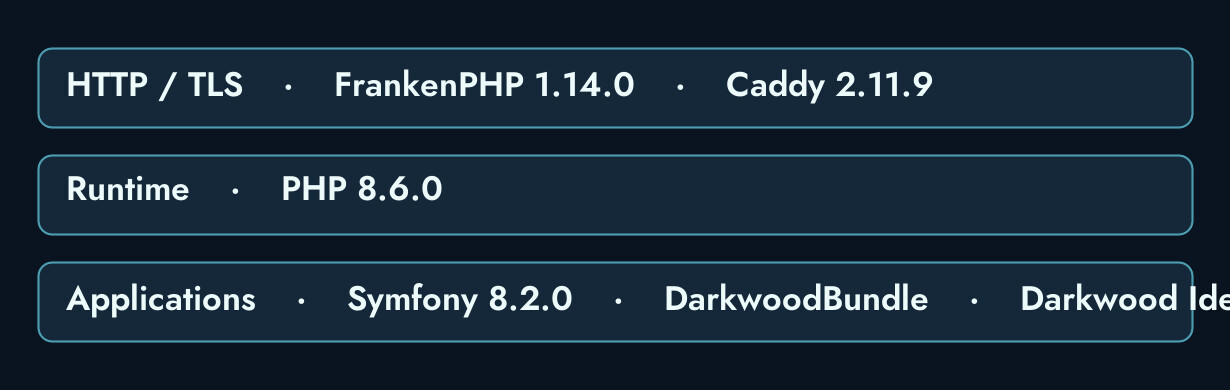
Flow’s development branch illustrates two reasons to use this PHP release. The first is partial function application. In a pipeline that takes the part of a string after the first character, the closure and the native form express the same step:
// PHP 8.5-compatible closure
yield static fn (string $value): string => substr($value, offset: 1);

// PHP 8.6 partial application on Flow's development branch
yield substr(?, offset: 1);
The placeholder leaves a slot for the input and the expression produces a callable. Flow can then pass its payload directly to that callable. The second example is Io\Poll. Flow’s PollDriver uses PHP’s native polling API to wait for read or write readiness and respect deadlines. The StreamSelectDriver follows the same cooperative idea with stream_select(). Both depend on yielding control at an appropriate point. A blocking library call still blocks its execution thread. We make no throughput claim from the API change alone.
The development branch also adopts Time\Duration for native polling deadlines and clamp() to replace nested min() and max() calls in cooperative stream waits. The server binary exposes those APIs, Io\Poll\Context and partial application. That runtime check says which PHP features are available. The Flow version selected by Composer determines which drivers the application can use.
Flow partial application example · PollDriver
The Symfony 8.2 features Darkwood adopted
The portal, Uniflow, Darkwaar, HeroClip, DJ Matyo, Geo, Job and Navi moved to Symfony 8.2.0. For each feature, we checked which application code it could replace and which product behaviour it had to preserve. Upgrade checks covered Composer dependencies, cache warmup, routes and asset compilation. Symfony 8.2.0 announcement
Native OpenID Connect
Darkwood Identity remains the identity provider. Client applications use the new oidc_login authenticator to delegate the authorization flow, PKCE, nonce and state checks, and token signature validation to Symfony. The applications keep their local account mappings and permissions. Sign-in was confirmed on Darkwaar, HeroClip, DJ Matyo, Geo and Job. Navi uses the same mechanism with an admin access check. Uniflow currently keeps its previous integration, restored after a regression with an existing account. Symfony Blog — OpenID Connect Login
Signed verification links
The portal uses UriSigner for new email verification links, binding each signature to the account identity and current verification state. Confirmation checks the account before saving the change. Symfony Blog — Symfony signed URLs
Local logout via POST
For local logout, Twig’s logout_button() generates a CSRF-protected POST form. Checks confirmed that logout routes reject GET and submissions without a valid token. Symfony Blog — Logout in Symfony 8.2
Authentication proofs
The portal also records the pwd method using AuthenticationMethodBadge after password verification. That records how the session was established. The single-use login_link flow is implemented and remains disabled in production while we validate delivery without tracking redirects. Back-Channel Logout and reauthentication for sensitive actions remain future work. Symfony Blog — Symfony authentication proofs
Import map integrity
Geo, Job and Navi generate SHA-384 integrity hashes in their AssetMapper import maps. The browser can verify the downloaded bytes against those hashes. We compared the published hashes against the resources actually served. Symfony Blog — Import map integrity in AssetMapper
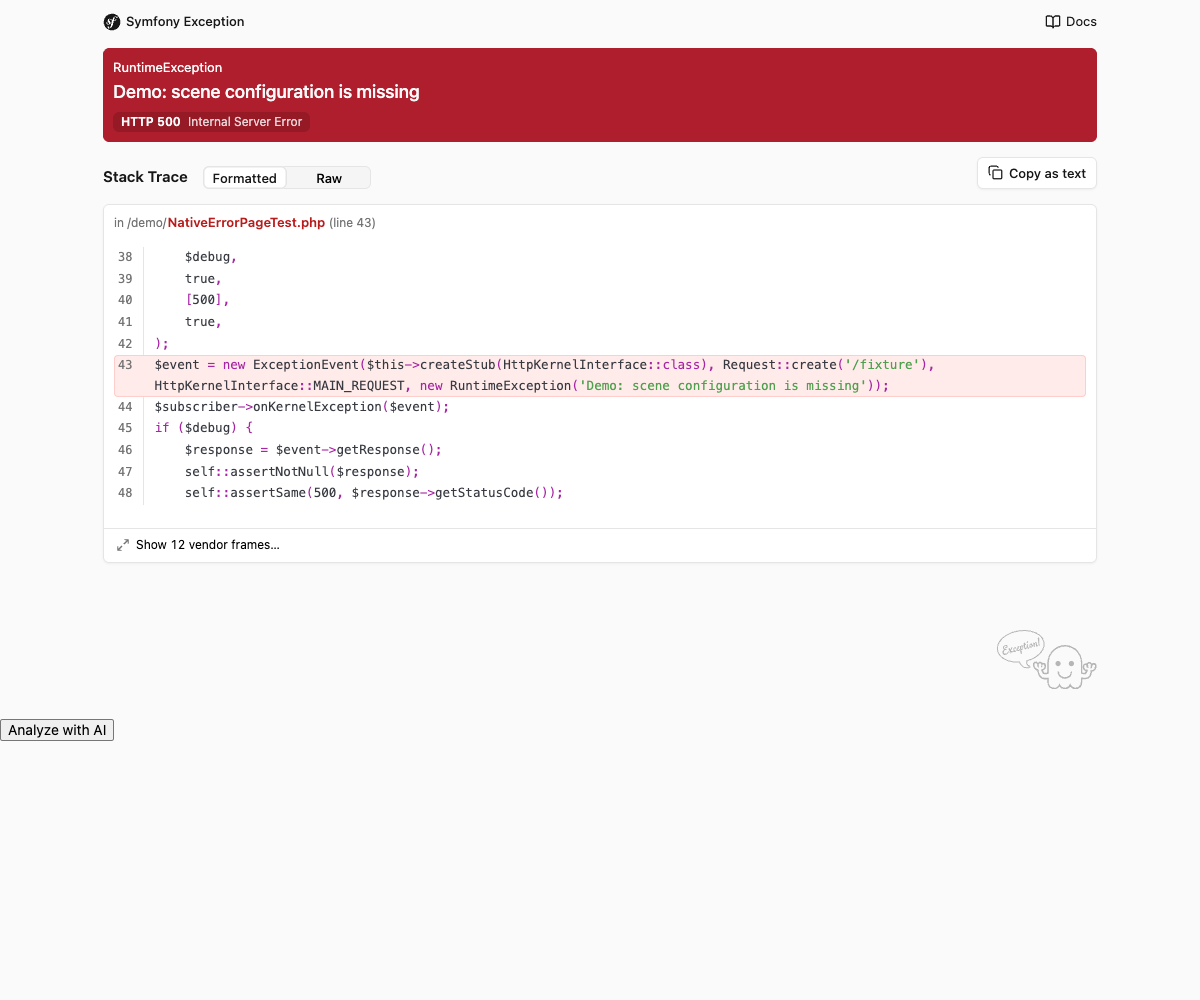
Native exception page
IA Exception Bundle removed its custom error page. It uses Symfony’s native debug renderer and adds an on-demand AI diagnosis action that sends a reduced exception context. Symfony Blog — Symfony exception page
Notifier bridges
Navi Core replaced its Facebook Page, Threads and Instagram publishing implementations with the official Symfony Notifier bridges. Mathieu Ledru contributed all three integrations to Symfony. Navi still handles its own checks, such as reading publication status. Symfony Blog — Notifier bridges
Five packages with separate release tags
- DarkwoodBundle distributes the shared Bootstrap theme, assets and Twig components. Read the release article · Packagist
- IA Exception Bundle brings AI-assisted diagnosis into the native Symfony debug page. Read the release article · Packagist
- MediaBundle takes YAML scene definitions through asset generation to a render manifest. The release carries the existing pipeline forward on Symfony 8.2. Read the release article · Packagist
- Navi publishes the workflow execution layer and a reusable GitHub Actions workflow for PHP quality checks. The internal application has its own publishing integrations. Read the release article · Packagist
- Flow aligns the PHP 8.5 maintenance line with the rest of the series. Its stable v8.2.0 tag points to the same sources as v8.1.12, including the same dependency constraints. Native partial applications and
PollDriverbelong to the next major release onmain. Read the release article · Packagist
The public monorepo holds the canonical source. Each component is mirrored to a GitHub repository for distribution. Prefixed monorepo tags record exactly which source tree was shipped. The distribution tags are indexed by Packagist so Composer can install each package independently. That lets us develop together and still support applications whose minimum PHP versions differ. Darkwood monorepo · Packagist vendor
DarkwoodBundle and the products
As the products grew, they each carried versions of the same navigation, colours and assets. DarkwoodBundle brings those elements together. The Bootstrap variables and component styles live in assets/sass/. The compiled CSS in assets/styles/ ships through Composer and Symfony AssetMapper. JavaScript, Jost fonts and SVG product logos live beside them. Applications can share headers, footers, controls and light, dark or sepia themes where supported, and keep their own styles for work such as displaying a map or playing a game. The bundle also supplies visual pieces for Darkwood Identity, while authentication stays in the provider and clients. Static pages and the Flow documentation consume shared assets through their own build paths.
The earlier Uniflow Sass and Darkwaar stylesheet served as starting points. Flow’s documentation helped validate the shared assets against a separate static build.
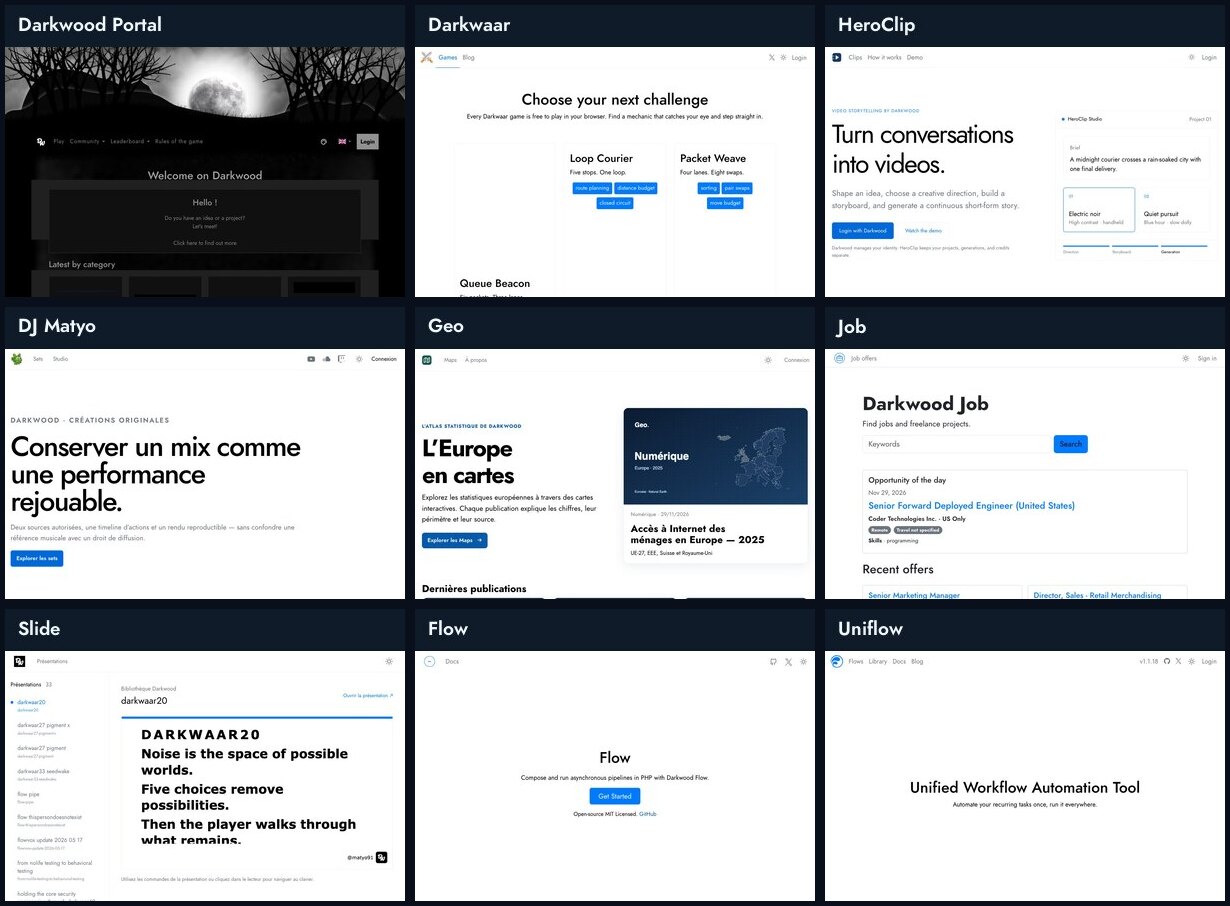
| Product | Website | What changed during the week |
|---|---|---|
| Darkwood Portal and Blog | darkwood.com · blog.darkwood.com | Shared navigation and centred article covers, localized releases and a Job embed that can link out from editorial articles. |
| Darkwaar | darkwaar.com/games | Shared styling and native sign-in alongside game work such as Loop Courier and Packet Weave. Browser exports and touch controls were tested for distribution. GamePix review submissions are distinct from public releases. |
| HeroClip | heroclip.darkwood.com | Shared UI and sign-in, and published animations such as The Closing Loop. |
| DJ Matyo | djmatyo91.darkwood.com | Shared branding and sign-in around the music catalogue. Return to Depot is one of the week’s sets. |
| Geo | geo.darkwood.com | Shared styling and sign-in, plus public visualizations such as passenger rail share in Europe and household internet access. |
| Uniflow | uniflow.io | Symfony 8.2 and the compiled theme, a fix for the signed-in homepage, and examples such as the public Route Order Lab workflow. |
| Job | job.darkwood.com | Launch of the job and freelance catalogue with source attribution, application tracking and Identity sign-in. Public listings are separated from private imports based on publication rights. The daily spotlight can reuse an eligible real offer. |
| Slide | slide.darkwood.com | Slides became Slide. Versioned JSON is now the source for external publication associations. We verified a backup restore and compared the records before retiring the dedicated PostgreSQL database. PDF exports and Speaker Deck links continue through the file-based workflow. |
| Flow documentation | flow.darkwood.com | Shared navigation and a refreshed PHP 8.6 example on the documentation site. The stable package continues to support PHP 8.5. |
The public Job offer highlighted on 29 November was available in the catalogue at the time of writing. Elsewhere, the public site catalogue moved to Page. Work on a Godot Web export for Hellcats also progressed as a separate experiment.
Automation gives the products something to share
With Darkwood Daily, one topic gives rise to products with different purposes. In Closing the Loop, a game, an animation, a music set, a workflow and a map give the reader different ways into the same edition. Navi coordinates publication and translations in French, English and German. The article can bring the results together through public embeds. When a Job spotlight is included, it comes from an existing real listing.
We are also following the open Symfony Messenger proposal for concurrent execution strategies. It targets Symfony 8.3 and suggests a possible way to connect cooperative execution with worker shutdown, acknowledgment and retries. We are studying how Flow could fit into those lifecycle guarantees. The proposal remains open and the study has not been deployed.
Where we want to go next
A shared runtime, identity and design give teams more freedom to keep products independent in the areas that matter. Native features and upstream contributions reduce the amount of code we have to carry together. AI agents help us review changes and coordinate repetitive tasks across the products. The contracts, evidence and decision to release remain engineering work.
Where do you draw the line between shared foundations and product-specific code? Which native PHP or Symfony feature has helped you remove a layer you once had to maintain? And what do you require an agent to verify before a change can reach multiple products?
The public darkwood-com/darkwood repository welcomes contributions. To report a problem or suggest an improvement, visit Issues or open a new issue.