⭐ Darkwood Daily — Exchanging Fragments
on November 27, 2026
How can you split a long sequence across computing devices and still send each one the fragments it needs? Navi’s 26 November watch highlighted DeepSpeed Ulysses. Sam Ade Jacobs and colleagues describe a sequence-parallel method that redistributes data with all-to-all communication to compute attention. The five creations in this edition each explore a different aspect of splitting or exchanging fragments.
Darkwaar — Packet Weave
Sixteen tokens occupy four lanes. Swap two tiles at a time and guide each shape into its matching lane in eight moves or fewer.
HeroClip — Signal Exchange
Three source groups send nine pulses. The paths cross, then each receiving group gets a signal from each source group.
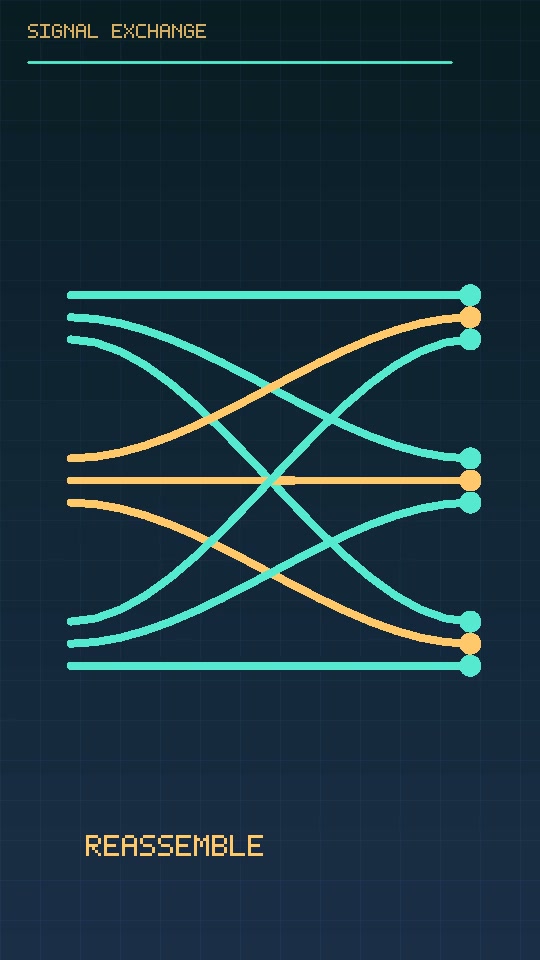
Three source groups send nine pulses. The paths cross, then each receiving group gets a signal from each source group.
DJ Matyo — Crossbar Sessions
Dispatch and Assemble are two original sixteen-second stereo tracks at 120 BPM. Notes move across the stereo field in the first track. The second rearranges the motif in a higher register.
Uniflow — Sequence Exchange
The workflow partitions a fictional sequence across three workers, counts their transfers and reconstructs the original order. The example returns ABCDEFG. The transfers take place in memory.
Geo — EuroHPC
The map compares the published sustained performance of LUMI (386), Leonardo (249.04) and MareNostrum 5 (215.40), in petaflops. Each value is for one machine. Grey countries are outside the selection. The EuroHPC profiles cite the June 2026 ranking. These measurements provide context on computing infrastructure.
References
- Navi — Veille Darkwood du 26 novembre
- Jacobs et al. — DeepSpeed Ulysses
- DeepSpeed — Ulysses sequence parallelism
- EuroHPC Joint Undertaking — Our Supercomputers