⭐ Darkwood Daily — Regaining balance: five creations around the recovery step
on November 24, 2026
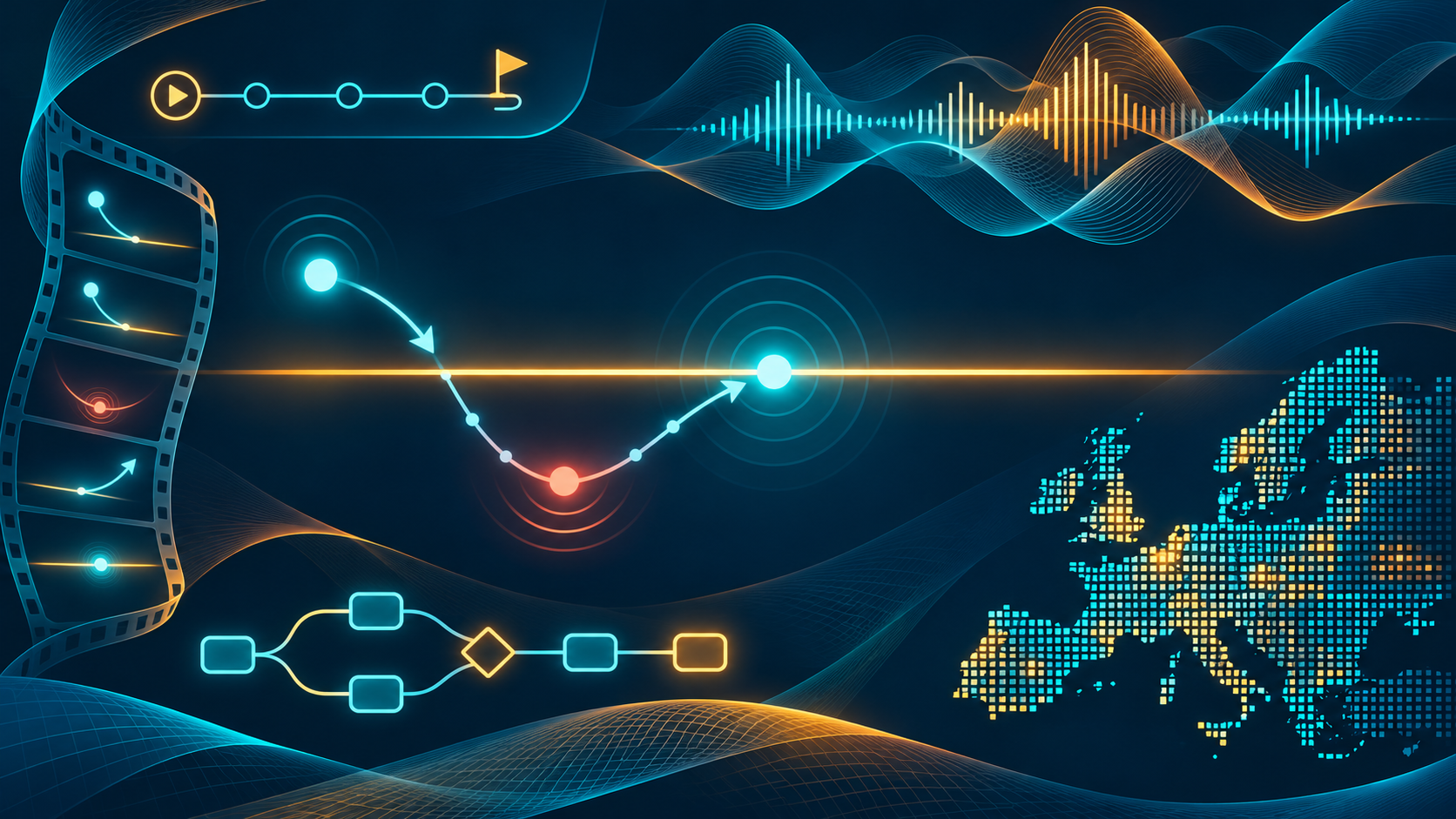
Darkwood Daily starts from the selections retained the previous day in Navi, then seeks what the same subject can become in five different media. For the edition of November 24, 2026, the starting point is the SlipAssist dataset: a research resource devoted to the body's reactions when a sudden disturbance requires regaining balance during walking.
The common idea is therefore not the fall, but the recovery. An imbalance occurs, a correction organizes itself and a new stability appears. This sequence becomes, in turn, a game mechanic, a visual movement, a musical progression, an explicit classification, and a geographical comparison.
Scientific Source — Observing the recovery step
The SlipAssist dataset, published on Zenodo under the license CC BY 4.0, accompanies work on balance-recovery assistance during walking. It documents an experimental protocol and provides artifacts intended for scientific analysis.
These data do not constitute either an individual diagnosis, nor a universal remedy against falls. The responses depend on the protocol, the participants, the sensors, and the research hypotheses. The creations of this edition carry forward the intuition of a perturbation followed by a correction; they do not claim to reproduce the participants' measurements or to validate a medical device.
Darkwaar — Recovery Step
In Recovery Step, a marker moves along a balance rail. Lateral pushes occur at regular intervals; the player must apply a counter-step to the left or to the right, then let the marker return to the center. Three attempts progressively make the perturbations more frequent and stronger, while a stability budget limits the errors.
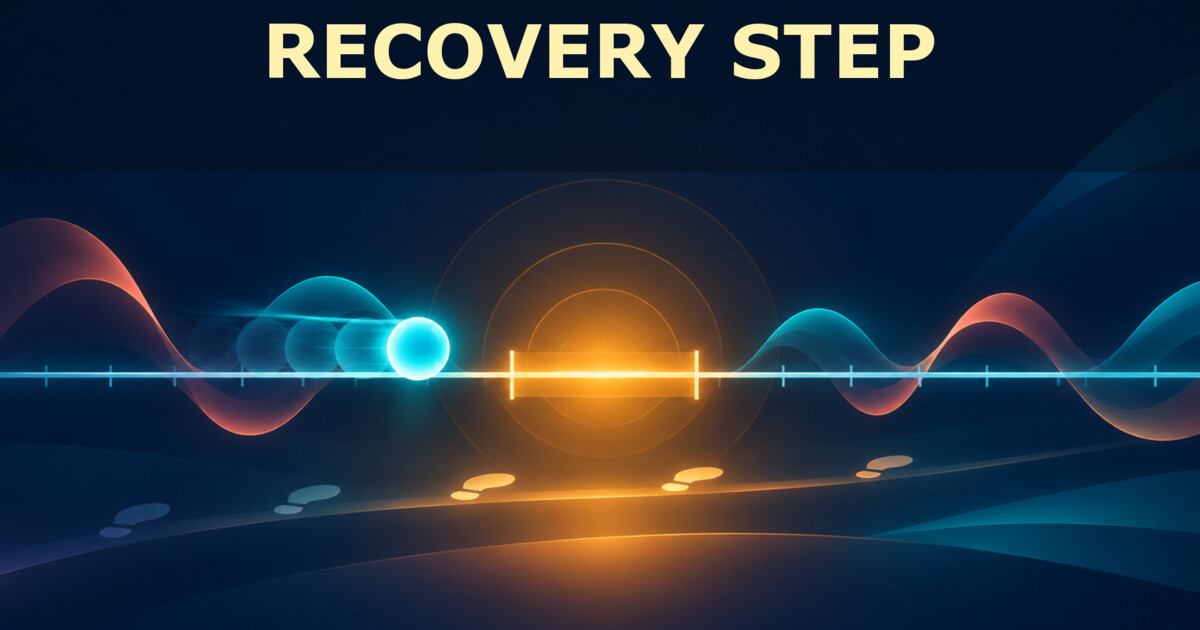
Contrer des perturbations latérales, retrouver le centre et terminer trois essais sans épuiser son budget de stabilité.
HeroClip — The Recovering Step
The Recovering Step transposes the same sequence into a vertical animation of 18 seconds. A stable trajectory is interrupted, veers from its axis, triggers a corrective movement and then centers again. The shapes and the soundscape are computed locally from a deterministic timeline.
The clip does not visualize any participant data. It makes perceptible a four-beat rhythm — stability, perturbation, assistance, recovery — with original geometry and a soundtrack.
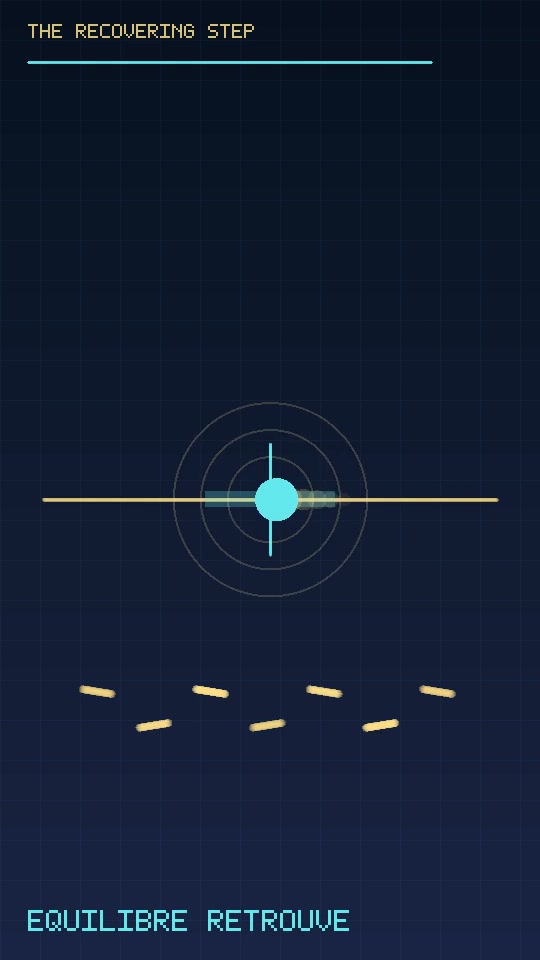
Une animation procédurale verticale où une marche perturbée déclenche un contre-pas puis retrouve son centre.
DJ Matyo — Counterstep
For Counterstep, DJ Matyo transforms the return to balance into musical tension. Two original pieces at 124 BPM respond to each other: Perturbation Line introduces the movements and ruptures, then Recovery Pulse reinstalls a more regular pulse.
The two audio files were synthesized for this edition, in PCM stereo 44.1 kHz, with no commercial track nor third-party sample. The replay of the set organizes events as a timeline: offset, reaction, stabilization.
Deux compositions électroniques originales à 124 BPM font alterner perturbation, contre-pas et retour à une pulsation stable.
Uniflow — Balance Recovery Classifier
The workflow Balance Recovery Classifier makes the transformation readable. It receives a short sequence of states, recognizes the phases stable, perturbation and recovery, and then returns a structured result with the counts and the processed sequence.
The public workflow can be run in Uniflow. Its input set is a synthetic demonstration: it shows a reproducible logic and explicit handling of categories, not a clinical model. The validation run returned four stable states, three perturbations and two recoveries across nine observations.
Run Balance Recovery Classifier in Uniflow
Geo — Slips, trips and falls at work in Europe
The Geo Card finally broadens the topic to a public statistic. It compares, for 2023, the share of reported work accidents associated with a slip, a trip or a fall, based on the Eurostat table hsw_ph3_06.
The map uses the unit % of reported accidents, the deviation DEV_5, the severity threshold D_GE4, and the full set of economic activities. It shows 30 countries out of the 32 expected; the United Kingdom and Liechtenstein remain reported without value. Declaration systems and national coverages must be taken into account before any causal comparison.
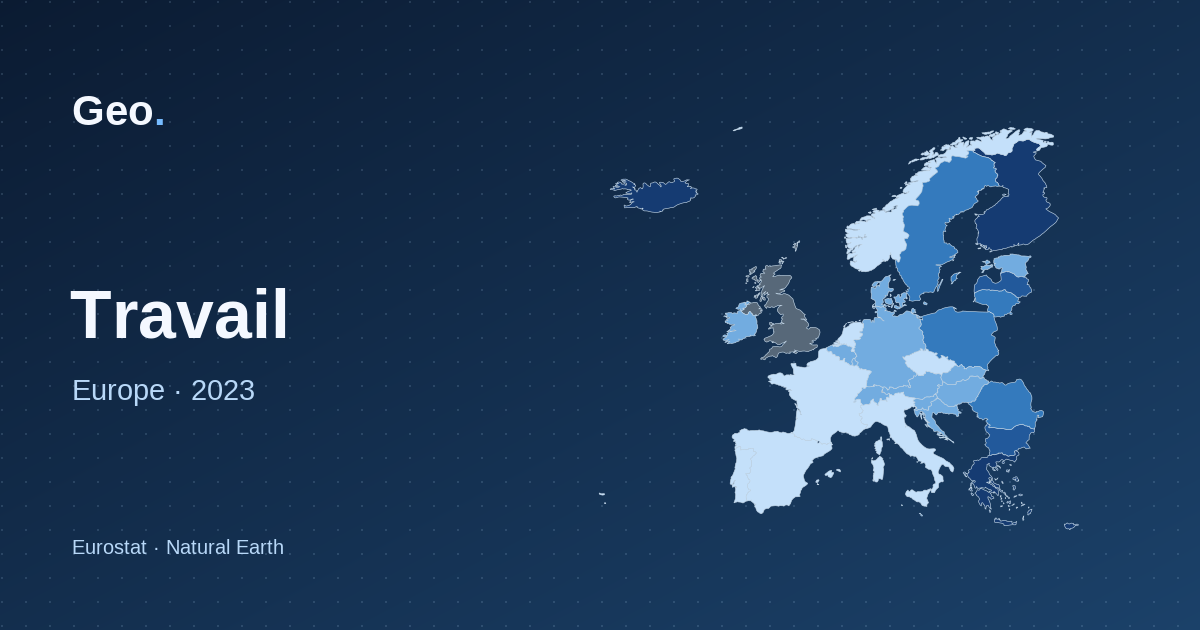
Part des accidents du travail déclarés liés aux glissades, trébuchements et chutes, Eurostat hsw_ph3_06, année 2023, unité %.
Five Ways to recover a trajectory
The game requires a correction at the right moment. The clip isolates the four phases of a movement. The music turns the perturbation into tension and then back. The workflow makes the categories verifiable. The map finally places the subject in a public statistic, with its unit, its year, and its limits.
These five objects were not computed from the SlipAssist data. They share a documented theme and each build an interpretation adapted to its medium. This is the principle of Darkwood Daily: preserve sources, explicate gaps, then create forms that are truly playable, viewable, listenable, executable and explorable.
References
- SlipAssist Dataset — Zenodo, CC BY 4.0.
- SlipAssist: wearable assistance for balance recovery, Frontiers in Robotics and AI.
- Eurostat — Accidents at work by deviation, hsw_ph3_06.