⭐ Darkwood Daily — What We Hear in a Musical Style
on November 25, 2026

A motif can change in timbre, rhythm, or density and still sound familiar. Which properties does a classifier use when it proposes a genre? For the 25 November 2026 edition, Navi selected Asfa Ahmad and Wildan Suharso’s supplementary results on that question.
The authors report comparing SVM, random forest, and k-nearest neighbours using audio features from 8,392 tracks across ten genres. Their protocol includes an artist-based separation between training and evaluation. The ODbL 1.0 record contains supplementary results. The tracks and the complete training set are absent. The sounds and examples in this edition were made independently.
Darkwaar — Signal Sort
Signal Sort represents each fictional signal with three bars. Send it to the station with the closest profile. After two rounds the pulse bar is hidden, and a single scan can reveal it. Three wrong routes end the run.

Signal Sort represents each fictional signal with three bars. Send it to the station with the closest profile. After two rounds the pulse bar is hidden, and a single scan can reveal it. Three wrong routes end the run.
HeroClip — Same Note, Three Colours
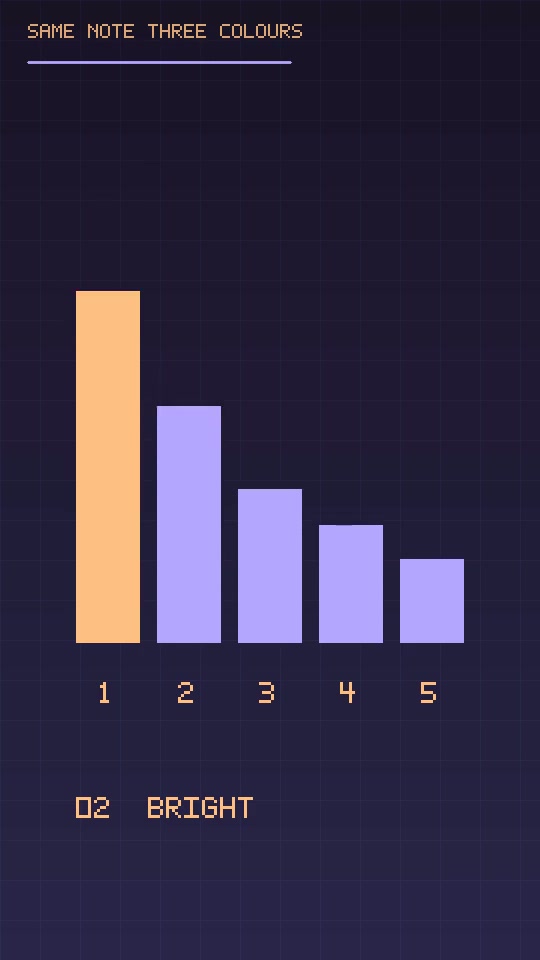
The vertical animation plays the same melody in three timbres. Five bars illustrate the relative amplitudes of the synthesis harmonics. Adding energy at particular frequencies changes the texture you hear.
The vertical animation plays the same melody in three timbres. Five bars illustrate the relative amplitudes of the synthesis harmonics. Adding energy at particular frequencies changes the texture you hear.
DJ Matyo — Two Measures
Two Measures unfolds in two arrangements at 120 BPM. Glass Measure lets the modulated plucks breathe. Copper Measure tightens the subdivisions and brings the drums forward. Both 48-second stereo tracks use original synthesis.
Two Measures unfolds in two arrangements at 120 BPM. Glass Measure lets the modulated plucks breathe. Copper Measure tightens the subdivisions and brings the drums forward. Both 48-second stereo tracks use original synthesis.
Uniflow — Audio Profiles — Artist Split
The workflow compares nearest-neighbour predictions on fictional audio profiles. The first mode permits artists to appear in both groups and gets 3 out of 3 correct. The second excludes the artist of each evaluated signal and gets 2 out of 3 correct. These results describe this example alone.
Geo — Attendance at live performances in Europe, 2022
The Eurostat map compares the percentage of people aged 16 or older who attended at least one live performance in the 12 months before the 2022 EU-SILC survey. The category includes theatre, concerts, and ballet. Twenty-eight of the 32 mapped countries have values. Germany, the United Kingdom, Iceland, and Liechtenstein have no observation.

The Eurostat map compares the percentage of people aged 16 or older who attended at least one live performance in the 12 months before the 2022 EU-SILC survey. The category includes theatre, concerts, and ballet. Twenty-eight of the 32 mapped countries have values. Germany, the United Kingdom, Iceland, and Liechtenstei
These five works invite us to listen, compare, and check what we measure. The study concerns musical categories. The map concerns attendance at live performances, a separate question at country level.
References
- Asfa Ahmad, Wildan Suharso — Supplementary Experimental Results for Music Genre Classification
- Eurostat — EU-SILC, ilc_scp03
- Eurostat — Cultural participation metadata