🚀 Fundraising vs. Bootstrap: Two paths to building a company
on April 29, 2026
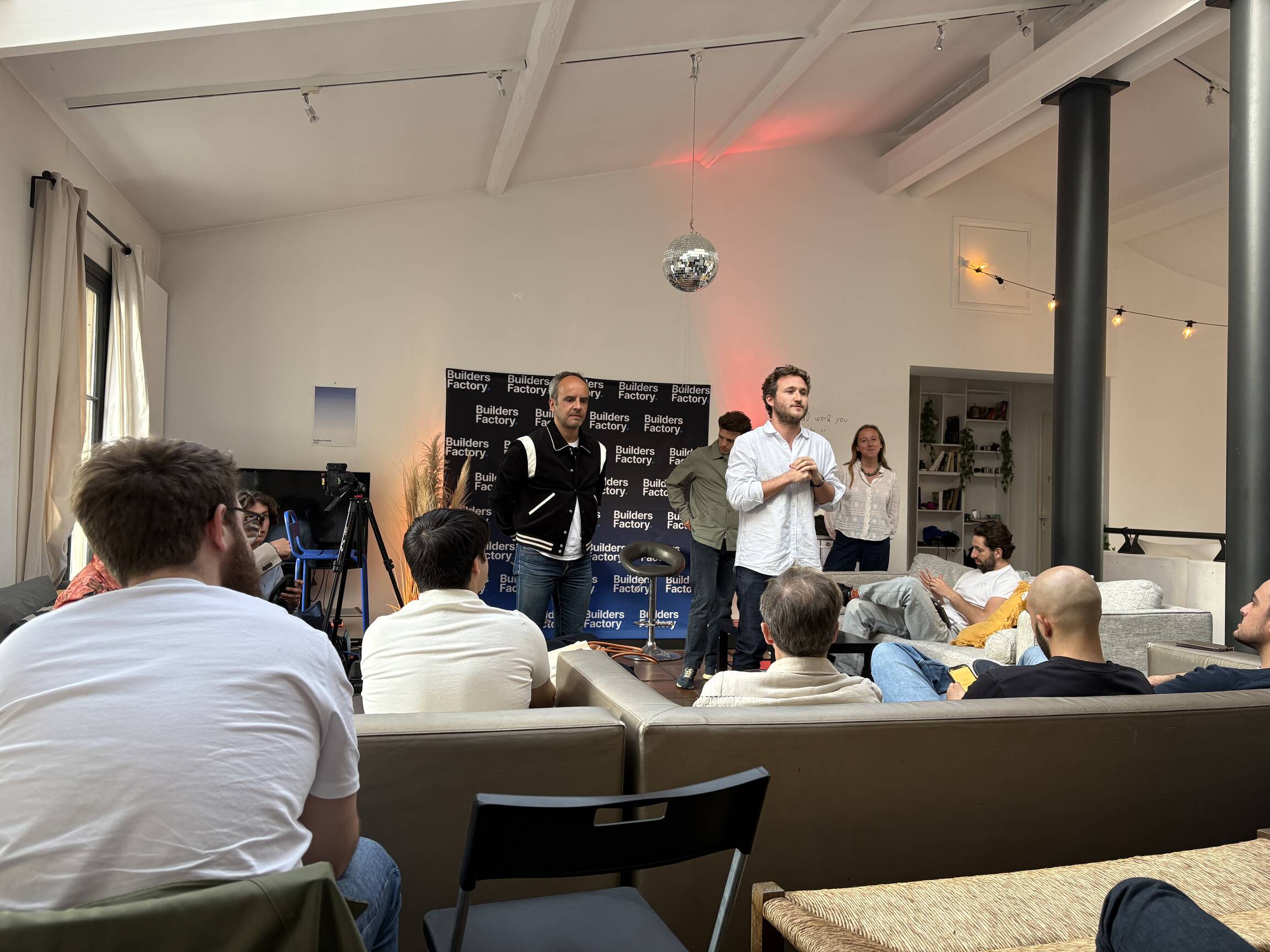
On April 28th, Builders Factory and NextGen VC organized a discussion in Paris around a seemingly simple question: Should you raise funds or build using bootstrapping?
Face to face: Étienne Genvrin, founder of Emma, which has raised several million euros, and Wilfried Granier, founder of Superprof, which claims impressive growth without raising funds.
Two opposing paths. Two visions of entrepreneurship. And above all, one central idea: there is no single right way to build a business.
The bootstrap: building a company that reflects you
Wilfried Granier defends a very personal vision of the company.
Superprof wasn't conceived as a startup to be sold, but as a company to be held onto. This difference changes everything. When you don't raise capital, you retain the freedom to decide, to experiment, to take your time, to make choices that may not seem rational on paper, but are consistent with your intuition.
The bootstrap also forces you to focus on the essentials: revenue.
No artificial runway. No growth financed by successive rounds of funding. The market responds directly. If customers pay, the company moves forward. If not, it must correct course.
This constraint can become a strength: it encourages creativity, efficiency, the building of a solid culture, and the search for sustainable organic levers such as SEO, community, user reviews, or gradual internationalization.
Fundraising: Accelerate, learn, iterate faster
Étienne Genvrin offers another interpretation.
For certain markets, particularly consumer applications or products requiring high execution speeds, raising funds can be almost essential. Funding allows for faster recruitment, more testing, and the ability to make more mistakes in less time.
But he insists on one important point: raising funds is a game.
This game has its rules, its codes, its expectations, its language. Many entrepreneurs fail to raise funds not because their project is bad, but because they don't yet understand how this game works.
Raising funds is therefore not just a question of business model. It is also a question of narrative, timing, network, perceived ambition, and the ability to embody a credible trajectory.
The real issue: alignment
The debate could have been reduced to “raise or not raise”. But the real question is deeper:
What type of business do you really want to build?
If your goal is to remain in control, to build for twenty years, to preserve maximum freedom, then the bootstrap may be the best path.
If your goal is to quickly capture a market, recruit expensive profiles, and move very fast in a sector where speed counts, then fundraising can become a strategic tool.
In both cases, the danger is misalignment.
Raising capital when you want a flexible structure can create ongoing problems. Bootstrapping when you're operating in a market where speed is vital can condemn the project to remain too small.
Advice is no substitute for instinct.
One of the strongest messages of the evening: entrepreneurship is learned through practice.
Listening to podcasts, reading threads, or attending conferences can be inspiring. But it doesn't replace being on the ground.
Entrepreneurial instinct is built by talking to customers, selling, recruiting, making mistakes, wasting time, correcting, and starting again.
This is also why we must be wary of absolute advice. Advice that's true for Superprof isn't necessarily true for Emma. A strategy that works in 2013 isn't necessarily effective in 2026. A tactic that works in France might fail in the United States.
The entrepreneur should not seek a universal rule. He must develop his own judgment.
Barriers to entry are built as you move forward
Another interesting point: at the beginning, it is often unnecessary to over-theorize about barriers to entry.
When you start out, you don't yet have 39 million teachers, millions of user reviews, a well-known brand, or an international database. These advantages aren't prerequisites. They're the result of years of operation.
The real initial barrier to entry is often the ability to continue when others give up.
Create a first version. Find a first client. Solve a first problem. Move from level 0 to level 1.
It's less spectacular than an ambitious pitch deck, but this is where the real building begins.
Conclusion
Fundraising and bootstrapping are not two opposing camps.
These are two different tools.
The fundraising buys time, speed, and visible ambition. Bootstrapping buys freedom, patience, and mastery.
The real issue, therefore, is not which model is superior.
The real question is which one allows you to build the right business, at the right time, with the right level of alignment.