🎤 Sunday Labs #4: What the Parisian builder ecosystem is really looking for
on May 26, 2026
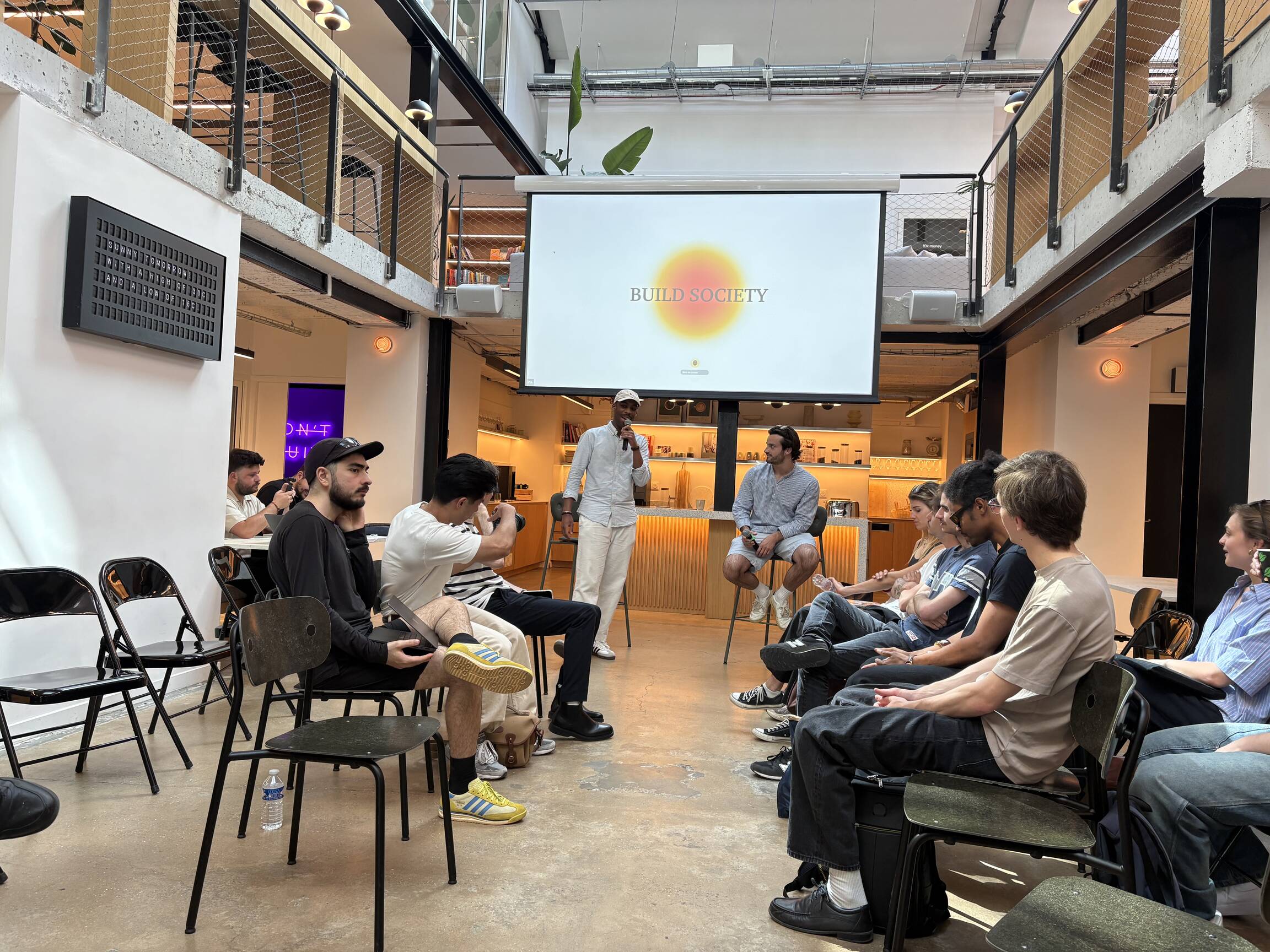
The fourth edition of Sunday Labs, organized by Build Society at Hexa (eFounders), in Paris, took place on May 24th.
The format was simple: to bring together builders, founders, freelancers, tech profiles and creators for open discussions, project presentations and networking.
No keynote address. No top-down conference. The main objective was to create useful exchanges between people who are already building something.
The central issue: why is Paris even less attractive than other tech ecosystems?
The first part of the event revolved around one question:
What does Paris need to become a more attractive ecosystem for investors and tech entrepreneurs?
Several themes recurred in almost all groups.
1. The lack of venues and builder culture
Many have mentioned the lack of spaces specifically designed for builders:
- hacker houses
- Startup-oriented cafes
- places open late
- Hybrid spaces between coworking and community.
The idea comes up often: in Paris, there are tech events, but few places where encounters happen naturally on a daily basis.
The parallel with San Francisco or New York has been made several times, particularly regarding the ease of meeting other people who are building.
2. The risk culture remains different
Another recurring topic: the perception of failure.
Several participants explained that in France:
Entrepreneurial failure remains stigmatized. Administrative processes are hindering some projects.
- The legal and tax framework may discourage early-stage profiles.
Conversely, the American ecosystem is perceived as more risk-tolerant and more aggressive on financing.
3. The topic of the American market
Founders in attendance also shared their experiences regarding the United States:
- creation of structures in Delaware
- seeking US funding
- access to a wider market
- higher valuations.
An interesting point: several people emphasized that French talent already exists, but that many projects end up going to the US for economic and distribution reasons.
4. Language and international openness
International participants also pointed out that:
- The language barrier remains a real issue.
- many events remain very Francophone
- Paris could be more accessible to foreign builders.
The issue was not presented as a rejection of French, but rather as a question of accessibility in a global tech environment.
Branding, content, and distribution: omnipresent topics
Another important part of the discussions concerned content and personal branding.
The shared observation:
- Publishing regularly remains one of the best ways to find clients, partners, or opportunities. LinkedIn still works very well for B2B.
- Substack becomes interesting for more technical or specialized niches.
Several participants were already using:
- AI workflows for writing their posts
- agents to automate publishing
- monitoring and content generation systems.
An interesting point raised during the discussion:
The problem isn't necessarily AI on LinkedIn, but the lack of depth in much of the content.
Substack has been cited as a higher-quality alternative for developing longer reflections and reaching more targeted audiences.
Projects presented during the event
As is often the case in this type of format, the most interesting part remained the discussions about ongoing projects.
Some examples:
A consumer OS Agent
One participant was working on a simplified interface for OpenFlow with the following idea:
- make AI agents accessible to non-technical users
- centralize a user's "digital life"
- automate certain tasks via personal agents.
A social matchmaking platform
Another project focused on relational matchmaking applied to events.
The idea:
- Use questionnaires about values, emotions, and profiles
- create relevant groups during events
- to facilitate encounters, especially for introverted profiles.
Serend
The project is presented as an “anti-feed social network”.
The principle:
- only one new encounter every three days
- no scrolling
- no visibility logic
- only conversations between compatible profiles.
The positioning was clearly oriented against the classic mechanisms of current social networks.
Meetable
Networking platform via small group dinners.
The objective:
- Connecting entrepreneurs, freelancers and complementary profiles
- to encourage more qualitative exchanges
- Create matches based on skills + human compatibility.
LinkedIn Scraping and Intent Signals
One participant also presented a large-scale LinkedIn scraping infrastructure:
- monitoring of recruitment
- detection of changes in companies
- generation of purchase intent signals
The topic quickly drifted towards technical limitations, scraping, datasets and possible business models.
What this type of event shows
The most interesting aspect of Sunday Labs #4 was probably not a specific project.
It was more about the level of openness in the discussions:
- sharing of real-world problems
- direct returns
- debates on economic models
- very early-stage exchanges
We are also seeing an evolution in the format of startup events in Paris:
- fewer conferences
- more discussions
- more small groups
- more projects under construction.
The Parisian ecosystem may still lack structure and capital compared to the US, but there is clearly a generation of builders seeking to create its own formats, its own communities and its own networks.